Recently, you may have seen a news article discussing the newest addition to the Department of Environmental Conservation’s New York State Birding Trail: Broad Cove Preserve in Aquebogue. Notable for being the first North Fork preserve added to the Trail, as well as for the recency of its preservation, Broad Cove is strategically placed on the northern coast of Flanders Bay, making it a hotspot for a wide variety of birds, including many migratory species. The month of May is one of the two primary migration seasons on Long Island. That fact, coupled with the Peconic Land Trust’s assertion that they significantly improved the preserve’s trails, was what drew me to this preserve.
One of the things that I often highlight in this series is parks that feel “tucked away.” My personal favorite parks are those which feel physically removed from human society, as though upon entry, one steps into another world. Broad Cove Preserve taps into that magical feeling perfectly. The entrance sits just off of Overlook Drive, in Aquebogue, at which point a long, winding path takes you through the forest and to a sizable gravel parking lot. While this lot has a decent capacity, it is crucial to note that this preserve has NO PUBLIC FACILITIES. That means no bathroom, no port-a-potty, no garbage can. Fortunately, it’s quite close to downtown Riverhead, and if you’re coming from west of the preserve (as I did), you’re almost certain to pass through there. So, make sure you stop somewhere in town if need be, especially if you had a long drive and anticipate spending a good amount of time at the preserve.
Stepping out of the car I was immediately greeted with a delightful chorus of birdsong. Most exciting for me, since it’s a bird I always have trouble finding, was the Blue-winged Warbler, a delightfully bright migratory bird which lingers on Long Island throughout the summer. At the start of the trail there is an informational sign, and a few other such signs appear sporadically across the preserve, providing insight into the area’s history and ecology. A handful of large, high benches also appear along the trails, and the Land Trust very wisely placed these benches atop the same gravel as the trail, meaning there’s no brush growing beneath them so you can sit down stress-free.
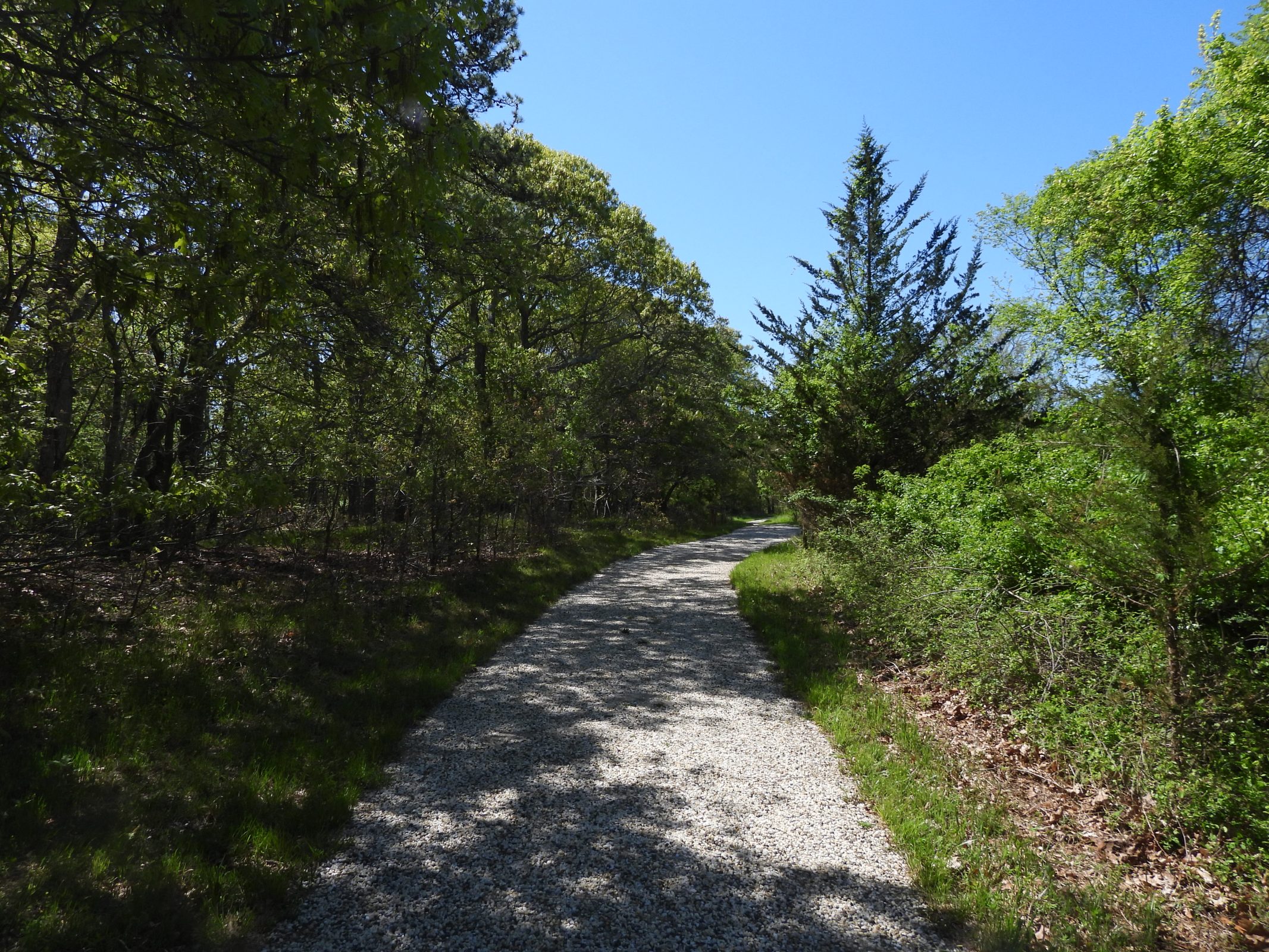
From the parking lot, the trail splits in two. Both the left and right paths consist of wide, gravel paths for basically their entire duration, meaning they provide an effectively stress-free hiking experience. Dress properly, and walk down the middle of the trails, and you shouldn’t have too much to worry about from ticks. The leftward trail ends in a mulch roundabout once you reach the coast, and the right trail changes to a sandy, somewhat overgrown trail only when you reach the estuary proper. I spent nearly two hours at the park, and I could have spent even more time, since there was no end to the birds.
As previously mentioned, May is a prime time to observe migratory birds, and there was plenty to see at Broad Cove. Most notable on my visit was the Black-throated Green Warbler, a species which I’ve only seen once before, and which only remains on Long Island during the migration times of May and September. I heard several other species which similarly appear on Long Island in that limited time frame, but was unable to spot them. Naturally, I’m planning another visit before the end of the month.
It’s no wonder why Broad Cove Preserve was added to the State Birding Trail. Between its diverse habitat of forest and estuary, its extensive and diverse population of birds, and its excellently constructed trails, it’s an ideal locale for any birder. Whether you’re interested in warblers, eagles, or woodpeckers, you’re likely to find what you’re looking for here. So long as you keep in mind the park’s lack of restroom facilities, and plan accordingly, you’re sure to have an excellent time at this preserve.
By Travis Cutter, Long Island Pine Barrens Society