If you’ve been following our Facebook page, our Instagram feed, or our YouTube channel, then you may have seen our relatively recent feature “Life in the Pine Barrens.” These monthly videos focus on a single species of flora or fauna, and highlight what makes them important pieces of the massive jigsaw puzzle that is the Pine Barrens ecosystem. No species is too small to escape our notice, and in this month’s blog, we’re going to highlight just a few of the species we’ve covered in this series.
Common Yellowthroat
This migratory songbird’s feature was a little shorter than average, because gathering footage for it is extremely difficult! Common Yellowthroats frequent environments near bodies of freshwater and move frantically through the brush as they hunt for insects. Getting even a minute of quality footage was a treat, and the striking yellow belly of the female specimen we observed makes for a colorful display. Common Yellowthroats are actually a species of warbler, a family of migratory birds which frequents Long Island in the summer. Some species only stop by briefly in May and September, while others stick around the Island to breed. Common Yellowthroats are one of the latter species, and so if you like the brief peek at them from this video, then be sure to head out into the Pine Barrens and see them for real!
Inkberry
Inkberry is one of many species of berry-producing plants found throughout the Pine Barrens, though you might not notice it as you hike. These black berries are a delicacy sought by many species of birds, and so when you’re hiking you might only be able to recognize them by their flat, broad leaves. Inkberry gets its name from the color of its berries, and the fact that if you get the berries’ juices on you, you’re sure to stain your hands. Unlike other species of berry, Inkberry isn’t safe for humans to eat. So, if you are lucky enough to observe the berries in the wild, be sure to leave them for the birds!
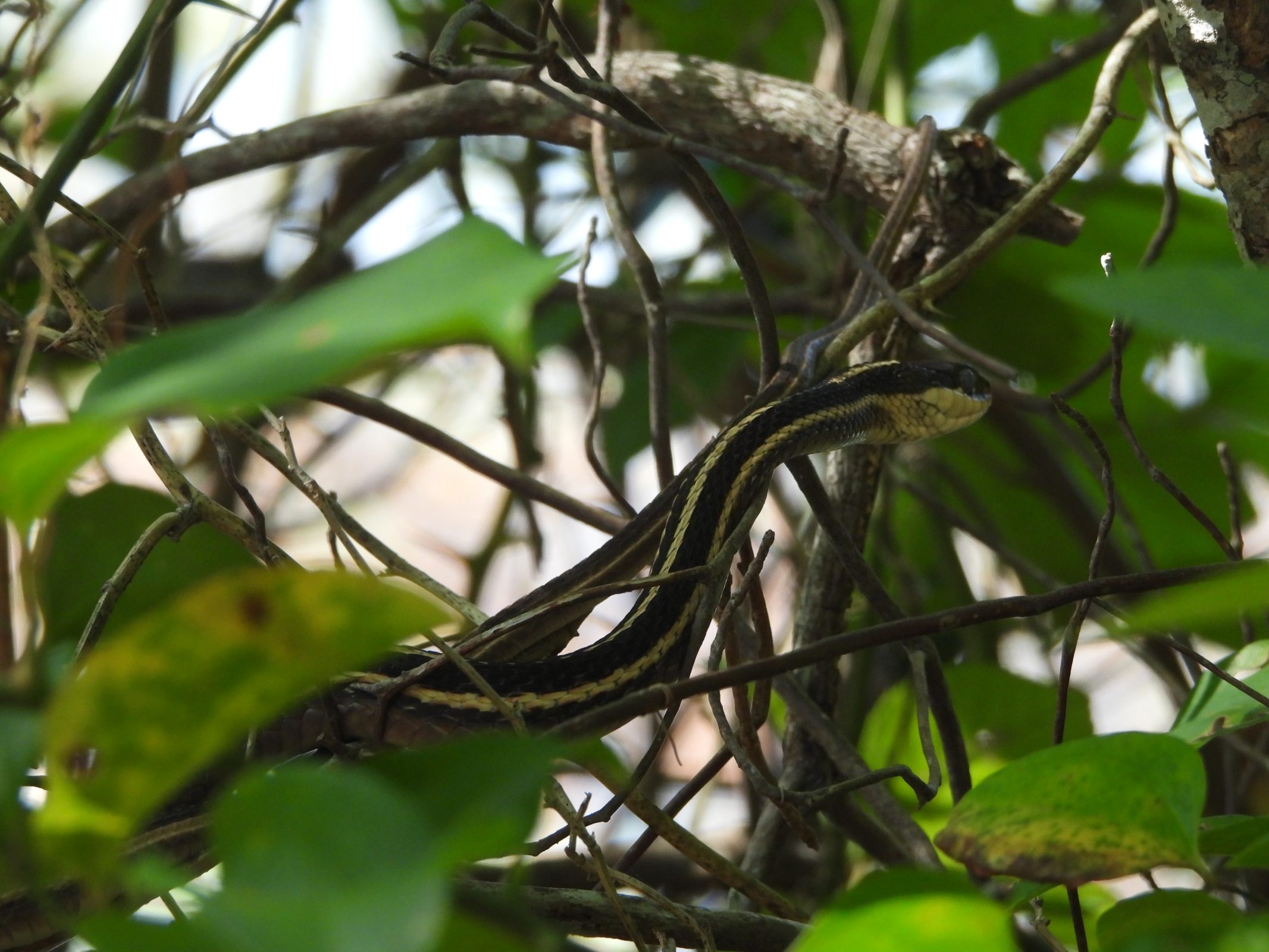
Eastern Ribbon Snake
Perhaps the single most exciting episode of “Life in the Pine Barrens” was the feature focusing on the Eastern Ribbon Snake, a true delight to film. This snake, which was remarkably positioned in the branches of a tree, was on the verge of molting, rendering its eyes milky, its senses dulled. We were thus able to get much closer than we might otherwise be able to (though we maintained a respectful distance of several feet), and thus secured this up-close, highly detailed footage. Observing not only the shape of the snake, but of its individual scales revealed how truly stunning these often-stigmatized animals really are. And seeing a snake climb a tree, despite lacking the digits usually required of such a feat, perfectly demonstrated the remarkable ingenuity with which these creatures navigate the world. While many people fear snakes, it’s important to note that Long Island’s species – which total a baker’s dozen – are not venomous and so pose no serious danger. If you encounter one of these remarkable animals in the wild, maintain a respectful distance, but appreciate how lucky you are to catch a glimpse of these elusive reptiles.
We hope you’ve enjoyed this sampling of “Life in the Pine Barrens.” This is a feature we’re very proud of, and intend to continue producing. There are ten features currently posted, and we’ve also produced an episode of our TV show compiling many of these features, as well as a few species that aren’t yet featured in their own episodes. If you’d like to catch up with this program, be sure to visit our YouTube channel, where all the episodes are archived. And follow us on Facebook and/or Instagram to keep up with new episodes as they appear!
By Travis Cutter, Long Island Pine Barrens Society