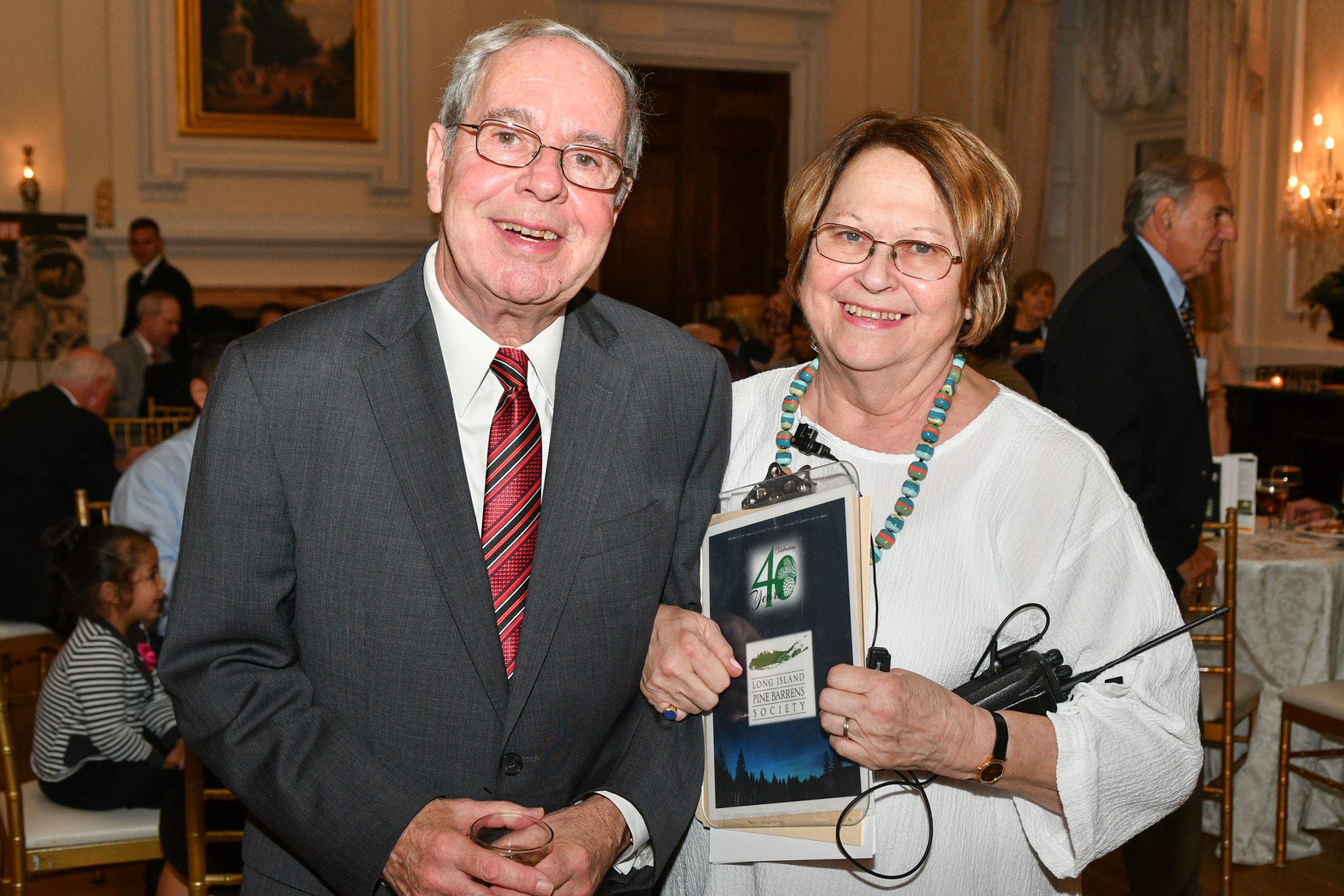
Dick Amper has left this world. He has also left behind a deep and lasting legacy on Long Island.
It is a living legacy, over 100,000 acres in size, and still growing. It is a type of legacy few people have aspired to leave, and fewer still have succeeded at creating.
Dick did not do this alone. Key to understanding how he managed to do what he did is to start by acknowledging the thousands of other players Dick interacted with, in an intricate ballet that spanned almost four decades. Many, but by no means all, are or were members of the Long Island Pine Barrens Society.
Dick did not create the Society. He was invited by its nascent board to come onboard as our first Executive Director. The three founders, all field naturalists, had decided that if the Society was going to have a chance to save what was left of the Pine Barrens, it would be by ‘professionalizing’ the Society. That meant legally incorporating and finding a leader who could enter Teddy Roosevelt’s arena of political combat on behalf of not a person, or a group of people, but all the people. Someone who fully understood what was at stake, and had the chops to fight for it, incessantly, and win. A heavyweight.
Dick clearly, from the start, was that person. We knew from the outset that we were in powerful hands.
Dick, by the way, never felt that way. This was a deep source of his strength. Another was his background in public relations. He had followed his father, who had worked for Governor Rockefeller, into that profession.
But the Society had other strengths as well. They were embodied in history, primarily the history of an earlier battle to save the Albany Pine Bush. Out of that decades-long campaign had come a series of court decisions tailor-made for application to the far larger landscape of the Long Island Pine Barrens.
One of our biggest strengths, which paradoxically was also a huge weakness, was water. We, here on this fair island, live on top of the water we drink. We are one of the largest, most concentrated and developed communities in the world doing this crazy thing. We do it because Long Island is one of the most serendipitous places in the world to live and raise a family. Even in its vastly more degraded state now, it still is.
Dick had a visceral sense of how important that simple fact was. His beloved wife Robin contracted breast cancer on Long Island. Suspicions ran high about the connections between polluted drinking water being pulled from under everybody’s houses, roads, stores and factories, and the high cancer rates across the Island.
There was only one place that was still recharging uncontaminated rainwater. That was the Long Island Pine Barrens, which also happened to contain the biggest deposit of rare and endangered organisms left in New York State. That’s saying a lot in a large state with two huge, world-renowned forest preserves, among many other amazing, unique and beautiful gifts of Nature.
Dick knew in his heart that combining the Transcendentalist view of unspoiled wilderness with the hard-headed, practical ‘water argument,’ he, and the Society, could convince the people of Long Island to back the Society’s charge to preserve the Pine Barrens. In addition, he came to learn, quickly, that we had an ace in the hole, a series of court precedents we could build a mega-suit upon that would do the impossible – stop every development planned in the Pine Barrens. And there were hundreds of them.
The suit was constructed in record time. We relied heavily on the earlier legal work in the far smaller Albany Pine Bush, contacting attorneys there and down here to expand the arguments and documents used so successfully in the Albany cases to include the crucial drinking water issue along with the ecological case for the far larger Long Island Pine Barrens. Dick and Robin ran this operation out of their house. They spent enormous amounts of energy working with many allied public groups, who provided information and affidavits in support of the Society’s efforts.
When the suit dropped, late in 1989, all hell broke loose. Almost 250 pending projects involving thousands of acres across the Pine Barrens were frozen. Dick and others began receiving death threats. Dick went to the media and revealed them, and got the malign forces to back off. The same happened with threats of so-called ‘slapp-suits’ (Strategic Lawsuit Against Public Participation),’ which were commonly used by powerful interests to harass opponents. Dick was fearless, and so, therefore, were we.
The suit took four years to run through the court system. It lost at the lowest level, then won at the first appellate level, then headed to the highest court, the Court of Appeals, for final disposition. During this time Dick lead a back-and-forth battle of words and images in all the available media (there was no internet, in the sense we know it now, then), while at the same time running back-channel discussions with developers, their organizations, and politicians of all stripes and parties about what it would take to resolve the matter by actually preserving the Pine Barrens, while funneling development into places that were already partially developed and therefore degraded as natural habitat and clean groundwater recharge areas.
By keeping this cause front and center for that length of time, Dick ensured the public was aware and stayed supportive of the Society’s legal effort. Politicians were aware of it as well, both locally and up in Albany. This would prove crucial to forging the solution that led to the Pine Barrens Preserve.
In 1993, the Court of Appeals punted. It declared that the State Environmental Quality Review (SEQR) law did not have the specificity to apply to such a large bundle of applications over such a large area, even though nothing in the law forbade it. Instead, the Court remanded the case to the State Legislature for consideration of amending the law.
This was a huge disappointment, but Dick, and we, the Society, were ready to pivot. And so, Dick declared we would simply challenge each application, one at a time, using all the same arguments we’d made en masse in the original suit. That brought everyone Dick had been talking to while the suit went on, to the table, or at least into the lobby outside the room. All the politicians and developers finally had been herded together to solve a real crisis on and under the ground, but only made urgent by Dick, backed up by the Society, allied civic and environmental groups, and the overwhelming voice of the people of Long Island in favor of preserving the Pine Barrens.
The rest, as they say, is history. Dick, as his last act, and with help from me and others who lived this story, completed his personal memoir, Saving Long Island: The David-and-Goliath Battle to Preserve the Pine Barrens, just in time before his retiring and passing. If you take the time to read it, you will hear Dick’s strong voice ring out once more. And in that powerful instrument, you will hear the stories not of Dick, but of all the other people he interacted with and relied upon to perform his particular magic.
This is the crucial takeaway from Dick’s telling. There is absolutely no ego there. It is all about others. Dick Amper, the once-powerful head who built a tiny naturalists’ group into the greatest environmental juggernaut Long Island will ever see, put everyone forward, ahead of himself. He made friends out of some of his most dedicated opponents. This truly humble man rose up and showed us how it is done.
By John Cryan, Long Island Pine Barrens Society Founder